EXPLORE / FUTURE EXPERIMENTS
What might
the flock become?
A gallery of experiments to explore through sound, movement, shared memory and new forms of decision-making. Each begins with something we might notice—and a question we can test.
CONCEPT GALLERY / Original schematic mockups. Readiness is stated for each idea; none of these images is a captured experiment.
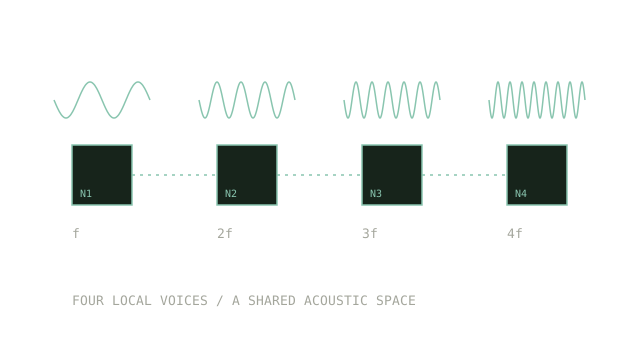
01 / HARMONIC COMMUNICATION
Could a flock
find its own harmony?
Each panel carries a voice. Repeated notes, intervals or short phrases could become cues that other nodes use when choosing what to do. A chord might make agreement audible; a disrupted tone might expose a disagreement.
- LOOK & LISTEN
- A changing spectrum of voices, local call-and-response, or clusters that settle into different pitch relationships.
- ASK
- Does a sound convey information that improves a task decision, or does it simply produce synchrony?
- COMPARE
- Measure decoding and task performance, not just shared pitches. Compare clean and disturbed runs with matched sound and energy budgets.
Host acoustic model implemented; physical learned harmonic communication proposed.
Read the acoustic research direction ↗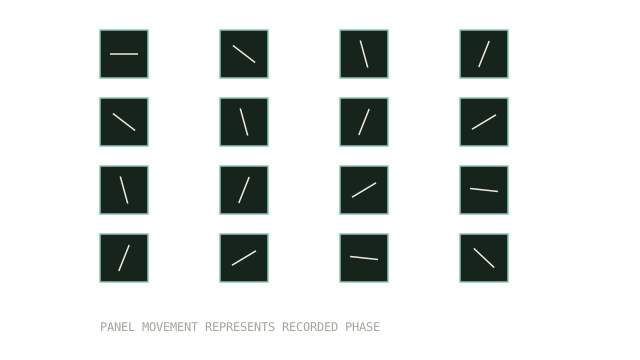
02 / SYNCHRONISED MOVEMENT
Let the wall
dance to what it hears.
A node could change its animation in response to the rhythm it hears. Local responses might grow into travelling waves, alternating groups or a shared beat. The interesting moment may be a break in the dance, followed by recovery.
- LOOK & LISTEN
- A wave crossing the wall, two groups moving in opposing phases, or one node briefly leading a transition.
- ASK
- Do the nodes coordinate through one another, or are they all following the same external sound?
- COMPARE
- Change the external beat and neighbour coupling separately. Measure phase relationships, participation and recovery; perfect unison is only one possible pattern.
Host phase-alignment metric exists; sound-driven physical panel choreography proposed.
Read the sound-driven animation proposal ↗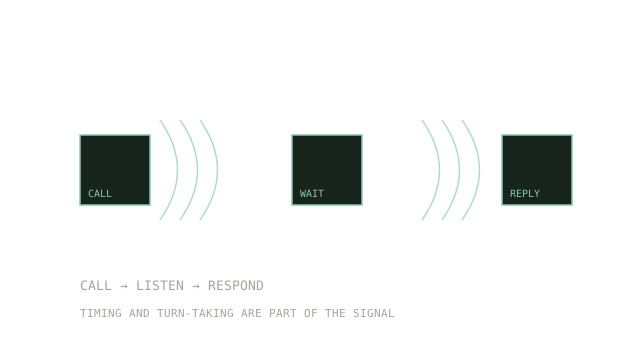
03 / ACOUSTIC TURN-TAKING
A call.
A pause. An answer.
Short chirps could act as beacons, acknowledgements or invitations to share. Timing, repetition and silence may matter as much as pitch. A room full of small speakers could make neighbourhoods and interruptions perceptible.
- LOOK & LISTEN
- Who answers whom, how long a reply takes, and whether repeated calls spread or fade.
- ASK
- Can a receiver distinguish a neighbour’s message from echo, its own sound or a replayed call?
- COMPARE
- Calibrate the acoustic path, record timing, and test an explicit decoding rule before claiming a learned language. Introduce an unexpected call using a controlled Kulira scenario.
Proposed physical experiment; microphones, speakers and calibrated firmware integration required.
Read the acoustic model and limits ↗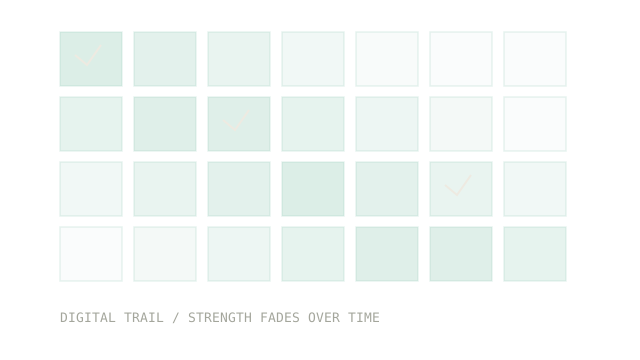
04 / MEMORY IN THE WORLD
Leave a trace.
Change what comes next.
Instead of sending every fact directly, nodes could leave temporary markers in the simulated world: this region was searched, this route was useful, this signal was doubtful. Later agents respond to that changing field.
- LOOK & LISTEN
- Trails that strengthen, fade or divert activity; a cluster that follows an old marker after its value has changed.
- ASK
- Can shared environmental memory improve coverage without becoming a channel for stale or forged information?
- COMPARE
- Compare no memory, private memory and shared fields with different decay rates. Track repeated searches, coverage, energy and sensitivity to false markers.
Documented experiment proposal; a physical pheromone-like display is a mockup.
Read the environmental-memory proposal ↗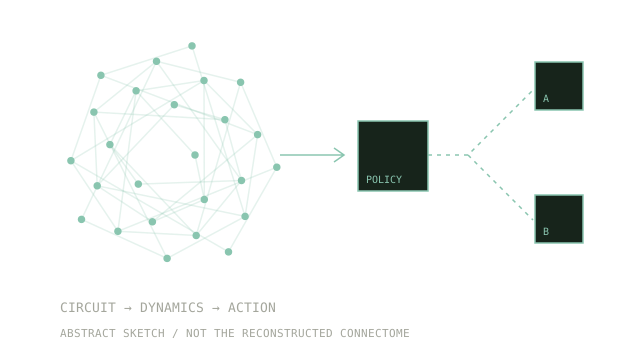
05 / CONNECTOME-INSPIRED POLICIES
A different kind
of decision-maker.
A future node policy could draw inspiration from a fruit-fly larva’s neural connectivity. The experiment would ask whether a small circuit-based controller offers useful dynamics, memory or action selection compared with the existing rule-based policies.
- LOOK & LISTEN
- Varied responses to similar situations, persistent internal state, or strategies that change as experience accumulates.
- ASK
- Which behaviour comes from circuit structure, which from its dynamics, and which from deliberately added stochastic choices?
- COMPARE
- Begin with a host model, specify neuron and synapse dynamics, benchmark against a simpler policy, then measure memory, compute and timing before choosing an ESP32 implementation.
Future research concept; no larval brain emulation or on-node connectome result is claimed.
Winding and colleagues published a synapse-resolution larval Drosophila brain connectome in 2023. Connectivity is a structural starting point; a running model also needs dynamics, inputs and outputs. Read the original connectome paper ↗
06 / TWO DIFFERENT KINDS OF VARIATION
An unpredictable author.
A repeatable experiment.
Meta AI models can generate different code or hypotheses across calls. That variability belongs to the development process. Once reviewed and built, the ESP32 firmware can implement deterministic experiment logic: the same specified state, inputs and event order produce the same decisions.
A future policy may deliberately sample among actions. A seeded pseudorandom generator can still make a stochastic model replayable. Live sensor inputs, scheduling and hardware timing also vary, so physical runs need their input and timing records. Randomness must be specified and measured; it is not evidence of intelligence by itself.
A connectome does not supply randomness automatically. We would need to choose and document any noise, sampling or stochastic dynamics, then ask whether they improve the objective.
See how model proposals become tested firmware ↗07 / GIVE THE IDEA SOMETHING TO RESIST
What happens
when Kulira joins?
A harmonic vocabulary could be imitated. A helpful chirp could be replayed at the wrong moment. A digital trail could lead the flock away from useful work. These are ways to investigate whether a strategy survives competition and misleading information.
Define the objective, baseline, intervention and failure condition before the run. A useful result may be a recovered rhythm, a stronger strategy—or a clear account of why the flock failed.