EXPLORE / KULIRA
Every flock needs
a difficult neighbour.
Meet Kulira: the adversarial actor that tests doubt, cooperation and resilience by making the experimental world less trustworthy.
01 / THE DESIGNATED ADVERSARY
The node that
makes trust difficult.
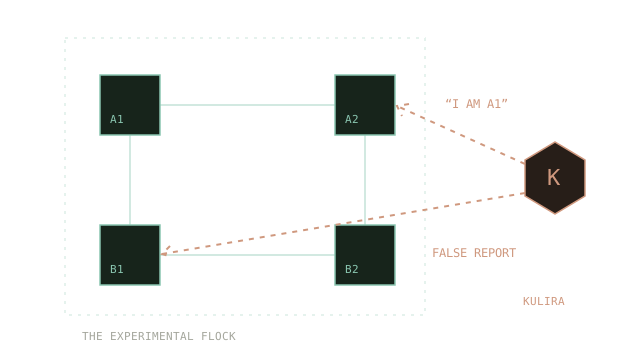
Kulira is the project’s “evil node”: an adversarial role designed to introduce noise, deception and interference into an experiment. It represents a competitor, a hostile neighbour or a source that benefits when the flock gets something wrong.
In the documented architecture, Kulira is a separate host rather than a seventeenth fleet panel or the central controller. The measured trust experiments execute in host simulations. An embodied, adaptive adversary is a further research direction.
Its scientific purpose is to make cooperation earn its success. Can the flock question a claim, preserve useful communication, and recover without becoming so suspicious that it stops doing its job?
02 / THREE WAYS TO DISTURB THE FLOCK
Interrupt. Impersonate.
Mislead.
“You did not hear that.”
A message arrives late, is duplicated, or never arrives. The question is how a policy handles absence and uncertainty without inventing a reassuring answer.
“I am your neighbour.”
A report claims another identity, repeats an old statement, or presents a copied report as a new source. The question is what the receiving policy believes about origin, freshness and independence.
“Trust me. I saw it.”
A recognised sender can still lie. Several copies of one observation can look like agreement. The question is whether the flock can distinguish corroboration from amplification.
In the published Kulira simulators, verified/forged origin is a supplied label. Those results test policy behaviour under that classification; they do not demonstrate cryptographic origin verification deployed on the panels.
03 / PRESSURE AND ADAPTATION
Improve, fail,
or find another strategy.
Nature contains cooperation, competition, predation and deception. Kulira brings a controlled form of that pressure into the experiment. A policy that performs well in a friendly world may fail when its assumptions are exploited.
“Improve or perish” describes selection among simulated strategies: candidates that fail the objective can be rejected, revised or replaced. Physical devices do not need to be destroyed. If a task models survival, energy exhaustion or exclusion, those are explicit scenario outcomes.
Pressure does not guarantee progress. An adversary can encourage useful doubt, excessive suspicion, brittle overfitting or total collapse. We therefore compare performance with and without the adversary, including the cost of caution and the ability to recover.
04 / WHAT TO WATCH
A lie can have
a visible shape.
Watch for a false claim spreading from one node into a cluster, several apparent sources repeating the same report, or a wave of hesitation after contradictions appear. In a future acoustic experiment, a misleading call could disturb a shared rhythm.
One report becomes three voices.
Does the flock treat forwarded copies as three independent observations? Compare a policy that counts reporters with one that tracks the original sighting. Keep the world and disturbance schedule matched, then inspect false decisions and honest-task performance.
That is the difference between a compelling adversarial performance and a useful experiment: record what Kulira changed, what each agent received, how far the effect spread, and whether the response helped.
05 / THE EVIDENCE SO FAR
Useful defences.
Visible limitations.
The published Kulira trust series reports host experiments involving copied reports, abstention, collusion, unreliable modalities, delayed feedback and reputation. Some proposed defences failed. The result is a set of bounded findings, not a claim that the physical wall has solved adversarial trust.
06 / THE NEXT ADVERSARY
A challenger
that can observe.
The ESP-MOSAICO proposal would let an adversarial device watch and listen to the wall, then propose disturbances based on what it perceives. The intended result is a changing challenge rather than one fixed sequence the flock can memorise.
Model-generated proposals, validated campaign actions and measured fleet outcomes remain distinct. The public documentation records a Glimmer/Hermes proposal and dry-run; it does not establish a completed adaptive live campaign. Experimental interference is kept separate from management, firmware recovery and evidence collection.